
This tutorial shows you how to build bridge deal recipes for an entire convention, and how to organize them into a cookbook. Here, we will assume you have access to the overall user guide, and so we won’t repeat basic how-to information.
The recipes I develop here are in this section of my bridge deal cookbook.
Subject matter
Choose a convention
While you may attempt to define “Standard American” or “ACOL,” those are systems, not conventions. Narrow it down to a single convention. If there are multiple versions of the convention, work on one of them at a time.
For this tutorial, we will define New and Improved Puppet Stayman over 1NT.
Choose your source(s)
You can find dozens of books and articles about most conventions. From those many sources, choose the ones that will guide your recipe development.
I have purposely chosen a convention that, to my knowledge, is defined very succinctly in just one source. Larry Cohen describes our convention in the second half of this web page.
Recipes
First recipe(s): as general as possible
This is the part where you sit down and think deeply about the convention. Read your sources thoroughly. As you read, notice the bridge language that can be turned into recipe setttings. Such language typically contains numbers of points, numbers of cards, and types of hands.
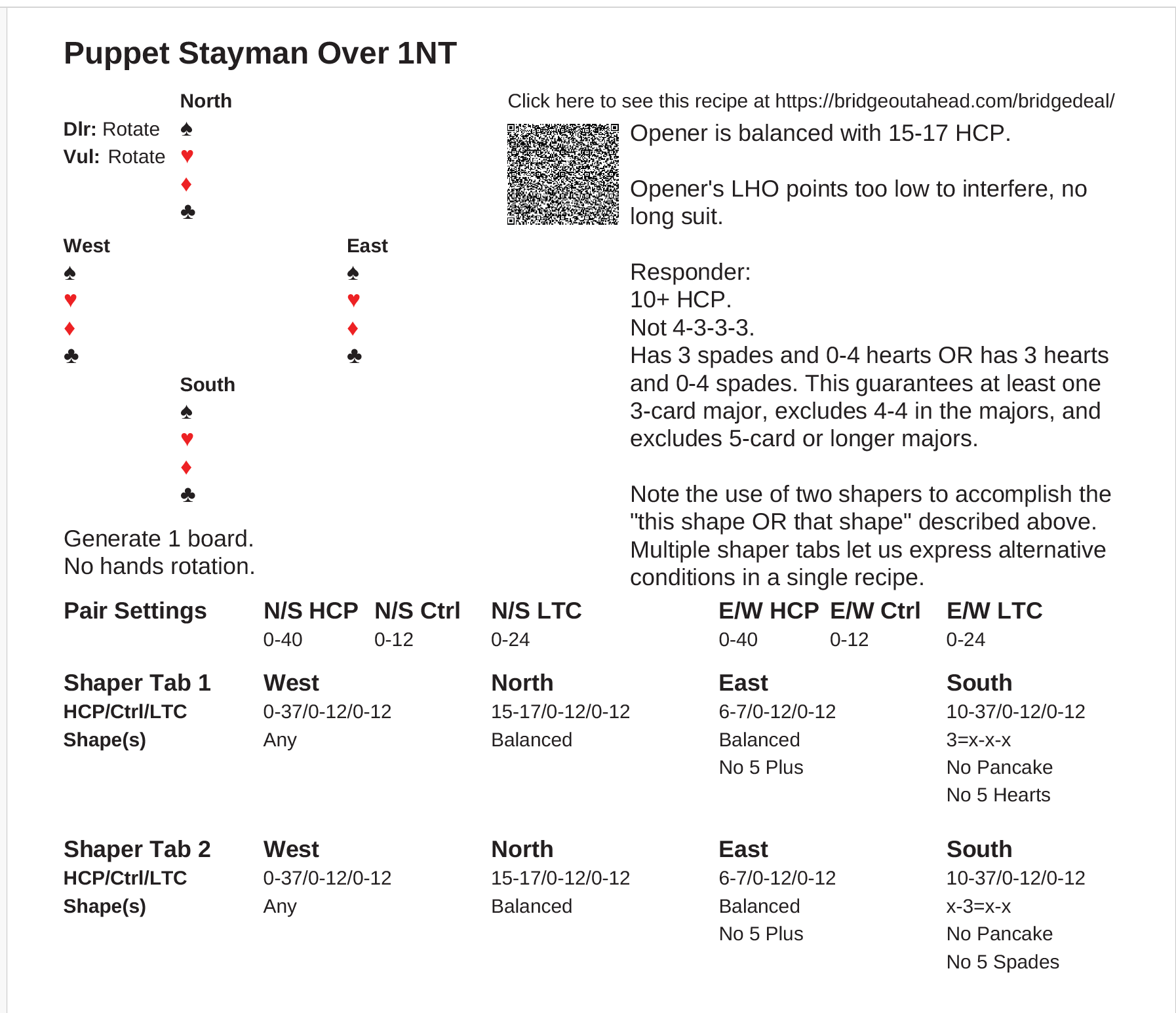
Our source says, “I like to use 1NT-3C as Puppet.” The 1NT is easily converted to recipe settings: a balanced shape with 15-17 HCP.
“[The Puppet Stayman user] will either have a 3-card major, or maybe a 3-card major and a 4-card major. Never use Puppet Stayman with a 5-card major.” Hark! This boils down to response hands with at least one 3-card major, and from 0 to 4 cards in the other major. Easily done with shaper settings.
“Responder should not use Puppet Stayman with 4-4 in the majors, nor with 4-3-3-3 shape.” If in your shapers you use an exact shape of 3 for one major, and limit the other major to 4 cards, you thereby exclude 4-4 in the majors. As for no 4-3-3-3 shape, that is so common that we have a shaper selection for it: No Pancake.
The picture emerges. We can develop a single general recipe for this convention. North has the 1NT opener. I give East a hand that is unlikely to inspire interference. The main action is in South (responder); there, we define the settings that can prompt a Puppet Stayman bid. It takes two shaper tabs (still in one recipe, though) because we define the response shapes once for a 3-card spade holding, and again for a 3-card heart holding:
List the variations you want
Used repeatedly, that recipe will eventually serve up all variations contained in the settings. You could pack up and call it a day. But it is much more useful, for you or for your students, if you can generate deals for specific variations on demand. This is a small, relatively simple convention. What variations might we want?
To identify the useful variations, think about the bidding sequences you would like to produce. Then think about the opener and responder shapes you will need.
Opener shapes
Opener any 1NT shape (the general recipe)
Opener 1NT with 5 hearts
Opener 1NT with 5 spades
Opener 1NT 4-4 in the majors
Opener 1NT with 4 spades and 0-3 hearts
Opener 1NT with 4 hearts and 0-3 spades
Opener 1NT with no 4-card majors
Responder shapes
Responder any Puppet shape (the general recipe)
Responder 3-3 in the majors
Responder with 4 hearts and 3 spades
Responder with 4 spades and 3 hearts
I have not specified any variations that always deliver 0, 1, or 2 cards in either major suit. It’s not that those don’t matter—it’s that I am most interested in the variations I listed above, and I don’t anticipate wanting to generate those with shorter majors (though I will get plenty of those at random with the original, general recipe). When building your own recipes for a convention, feel free to include as many or as few scenarios as you like.
Build the variations
Pop quiz! Close your books and put your calculators away.
Alice leaves Cleveland at 10:05 AM Eastern Time on a nonstop Westbound train going 50 MPH. Marvin leaves Kansas City at 11:05 Central time on an Eastbound train going 35 MPH. Marvin’s train will stop for 5 minutes at 3 stations along the way. While it may seem implausible, when in motion the train will always move at exactly 35 MPH. The occupants, presumably, are immune to the effects of instantaneous acceleration and deceleration.
Question: if I combine each Puppet Stayman opener variation with each responder variation, how many recipes will I have?
Answer: 28
I’m not sure what Alice and Marvin riding on trains had to do with that, but you know it is with word problems. They like to obscure the main point.
For this fairly simple convention, for the variations that interest me, I will need 28 recipes.
I have covered the idea of recipe themes and variations extensively over the years, both in random posts and in user guides. I will not step you through the process for all 28 recipes. I will just say that if you start with the first opener scenario and combine it with the four responder scenarios, you get something like this:

That’s four recipes, all with the same opener scenario. There are also four reports and report texts in there, but you can pick out the recipes thanks to the word RECIPE in bold print.
The first recipe is the one I showed you earlier in this post. The other three recipes change that recipe to fit each responder scenario.
That’s the first four. For the next four recipes, combine the second opener scenario with each of the four responder recipes.
Lather, rinse, repeat until you have all 28 recipes.
Organization
File System
The way you set up the folders and subfolders for your cookbook is the first step in keeping things organized. I use a 4-level folder structure with (conceptually) the book level containing chapter folders, chapters containing topic folders, and topic folders containing recipes and related files and/or subtopic folders. Here’s my file system:

I have no recipes for the “Hadder Modified” or “Original over 1NT” Puppet Stayman conventions, but I will eventually so I go ahead and make empty subtopic folders for them.
File Names
Within a topic or subtopic folder, use file names that cause your recipes to be grouped together logically. You can see that I have put two 3-digit numbers at the start of each of my file names.
The leading “000” is for all recipes with my first opener scenario. I then provide a second number representing the responder scenario that is combined with the opener. So you see files with “000_000”, then “000_001”, “000_002”, and finally “000_003” for the fourth recipe. That’s one group of four recipes.
The second group of four recipes all have the second opener scenario, and start with “001”.
This is a homemade naming convention; nothing in my deal generator knows or cares how the files are named.
Make it easy to use, and informative
Be descriptive
While I used the pairs of 3-digit numbers in file names to cause them to appear in a particular order, I also provide a description in the rest of the file name.

This is crucial, because a recipe doesn’t have any description built into it. You can make a recipe report if you like, and I have done so for some recipes. But for ease of use, ideally you and your users can tell the general purpose of a recipe without opening it and puzzling it out.
You can see that I put little snippets of descriptive bridge language in my file names—the kinds of things that become recipe settings.
Make a cookbook
So far, we’re just making recipe files and getting them organized.
Now make them into a cookbook web page.
Make deals, and do something with them
As satisfying as it is to create a set of convention recipes and make them into a cookbook, at some point we should play some bridge. What I like to do is use the recipes to make sets of playable deals. I then use them in my bridge-playing software of choice. There are many nice bridge-playing systems. I tend to use BBO. Here’s what my deal archive looks like:

“CC Tour” stands for Convention Card Tour. Once I make a file of deals for a convention, I upload it into a named folder in BBO. Then I can use it as a deal source in a bidding table or a teaching table, playing with robots or with friends.